CARE FOR US ALL
Making a better world, one little corner at a time.
Links
Successful Solutions for School Based Mental Health Programs
CARE
The CARE: Child and Adolescent Risk Evaluation
CARE: Child and Adolescent Risk Evaluation
Complete Kit Manual, 25 Assessment Forms, 25 Case Management Forms- $75.00
25 Assessment Forms $29.95
25 Case Managment Forms $29.95
Manual $19.95
Optional Tabulation Software (replaces Case Managment Forms $29.95
Order the CARE from Research Press
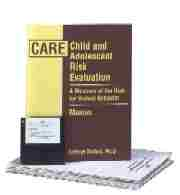
The 49-item Assessment Form measures risk factors (youth characteristics, peer relationships, school and education issues, family dynamics) and protective factors associated with youth violence. Using a combination of interview and file review, clinicians can complete the assessment and score the form in 15 to 30 minutes. The scored assessment form is then used to complete the Case Management planning Form. This form helps clinicians gauge the intensity of potential behavior problems and identify the appropriate level and types of interventions needed to prevent future violence. The planning form can be completed by hand or generated by using the optional Tabulation Software. The CARE Manual provides detailed instructions on the administration and scoring of the assessment form and for completing the case management planning form. It also discusses the development and validity of the program. This violence risk assessment tool can be obtained through www.researchpress.com.
A comparison of Youth Violence Risk Tools
There have been a number of previous attempts to use assessments as a method of determining level of care needs in children and adolescents who are at risk for violence. However there has been no clearly defined method for linking the assessment to the need for treatment, or the level of structure best suited to deliver this treatment.? (American Academy of Child and Adolescent Psychiatry American Association of Community Psychiatrists) Consequently, it is important to look at what assessment tools and intervention models are supported by research. Developing an effective range of services is based on the use of validated assessments of multiple areas of functioning and a cost effective system of care should be based on a validated tool to determine the level and intensity of services needed to prevent future violence. A reliable and valid case management tool is also needed.
Several instruments have been developed in an attempt to meet these needs. The CAFAS, CALOCUS, YLS/CMI, CARE, PCL-YV, SAVRY, CASII, and MAYSI are instruments that have been developed to attempt to meet these needs. All tools have acceptable reliability, a manual and peer review. All but the SAVRY have samples over 800. The CARE has the strongest correlation with level of services needed and out of home placement. The CAFAS, CALOCUS, CASII, YLS/CMI, and the CARE indicate level or intensity of services needed. Only the CARE provides suggestions for types and levels of interventions to be used to prevent future acts of violence.
 Bravenet.com